They Changed the Rules
Now Council President Natali Fani-Gonzalez is Changing the Math
Montgomery County has already made a series of decisions that are reshaping how people live along the corridors: Veirs Mill, University Boulevard, Georgia Ave., Colesville, New Hampshire and 20+ more.
Over the past few years, the County has increased allowable density, advanced corridor-focused growth strategies, invested in infrastructure like Bus Rapid Transit, and supported redevelopment through policy and incentives. These decisions are not isolated. Together, they change land use, increase land value, and accelerate redevelopment. Now, Council President, Natali Fani-Gonzalez is changing something else: how residents are taxed.
What the Policy Is
A proposal from Natali Fani-González restructures how tax relief is provided.
- eliminates the $695 homeowner property tax credit
- replaces it with income-based tax relief
- adjusts spending growth, including compensation increases
- avoids a direct increase to the property tax rate
The stated goal is to shift from a universal property-based benefit to one based on income.
What This Policy Does
This proposal does not reduce the County’s costs. The same obligations remain — schools, infrastructure, labor, and debt. What changes is how those costs are distributed and how predictable they are.
The homeowner credit was fixed and consistent. Its removal eliminates a guaranteed reduction in property taxes. The replacement is tied to income and can vary from year to year. It is not designed to offset rising property-related costs.
This shifts the structure of taxation without addressing the underlying drivers of cost. It does not lower home prices, reduce rent, or slow redevelopment pressure. It increases reliance on income-based revenue, which fluctuates more than property-based revenue.
At its core, this is a redistribution of tax burden, not a reduction of cost.
What Has Already Been Set in Motion
This proposal is not happening in isolation. The County’s long-term framework, Thrive Montgomery 2050, prioritizes growth along corridors through increased density and redevelopment. In practice, that often means replacing existing housing with higher-density development.
County leadership has acknowledged the implications. Planning Director Jason Sartori has identified fixed-income and financially vulnerable homeowners as most at risk of displacement. The Montgomery County Office of Legislative Oversight (OLO) has found that displacement is likely under current conditions.
What This Means for You
For homeowners, the impact is immediate. The loss of the $695 credit removes a predictable offset against rising property costs. Any replacement benefit depends on income and may change over time. In areas where property values are increasing, this reduces stability.
For those who recently purchased a home or are operating with limited financial flexibility, the margin for error narrows. Higher purchase prices and interest rates already limit affordability. Removing a consistent credit increases exposure to future cost increases.
For small landlords, operating costs increase while redevelopment pressure continues to grow. In corridor areas, rising land values make selling more attractive and holding property more difficult. This can lead to rent increases or the loss of lower-cost housing options.
For renters, income-based relief may provide some benefit. However, this proposal does not directly affect rent levels or housing availability. Those remain driven by market conditions and redevelopment activity.
For residents living along Colesville, Veirs Mill Road, and University Boulevard, this change adds to an existing pattern. These communities are already experiencing zoning shifts, infrastructure investment, rising land values, and increased redevelopment interest. This proposal removes a predictable form of relief while those pressures continue.
Bottom Line
The County has already changed the rules through zoning, planning, and redevelopment policy.
This proposal changes the math, how residents pay and how predictable that payment is.
It replaces a guaranteed benefit with a variable one. It does not address underlying housing costs or displacement pressures. And it operates in communities already experiencing significant change. For many residents, the concern is not just how much they pay.
It is whether they can plan, absorb, and remain in a system where both the rules and the math are shifting at the same time.
_______________________________________________________________________________________________________________
Planning Board Meeting- Public Hearing
US-29 BRT: What Planning Is Moving Forward — And What It Means
Thursday, April 23 at 9:30AM, Item #5
Agenda & Packet: April 23, 2026 - Montgomery Planning Board
Montgomery County Planning is advancing the next phase of Bus Rapid Transit (BRT) along the US-29 corridor, and this time it is not just conceptual it is moving into design and implementation. The Planning Board is reviewing what is called a “mandatory referral,” which is the formal step where a government agency in this case, the Department of Transportation seeks approval to move forward with a project that involves land use, design, and potential property impacts.
The project itself proposes a significant change to how US-29 functions. The County is advancing a median-running BRT system, which would place dedicated bus lanes in the center of the roadway for several miles, from Sligo Creek Parkway to Tech Road. This is not a minor upgrade. It represents a redesign of how the corridor operates, prioritizing transit movement over existing traffic patterns.
At a technical level, the goal is to improve speed, reliability, and connectivity for transit riders. The existing “Flash” BRT system already operates along US-29, and this next phase is intended to expand and enhance that system with more dedicated infrastructure. County leadership has consistently framed BRT as a tool to move more people efficiently and support long-term growth along major corridors.
But the staff report and the broader planning framework, make clear that this is not just a transportation project. It is part of a larger strategy to reshape the corridor.
What This Project Actually Does
The proposed design includes dedicated lanes for BRT buses, separated from regular traffic, along key portions of US-29. This requires physical changes to the roadway, including reconstruction of sections of the corridor and reconfiguration of how vehicles, buses, and turns are handled.
In practical terms, projects like this typically involve:
- changes to lane configurations
- new or modified intersections
- adjustments to access for nearby properties
- potential land acquisition or easements to accommodate widening or redesign
The Planning Board’s role is advisory, but approval of this step allows the project to move further into design and eventual construction.
Why Planning Is Advancing This
This project is not standalone. It is tied directly to the County’s long-term growth strategy under Thrive Montgomery 2050 and the Countywide transit corridor framework.
The underlying logic is consistent across County policy:
- invest in high-capacity transit
- concentrate growth along corridors
- increase density near transit infrastructure
BRT is not just about buses. It is about supporting a different land use pattern, one where more people live, work, and travel along these corridors.
County materials explicitly connect BRT to:
- improved mobility
- economic development
- and support for higher-density development patterns
What This Means for Corridor Communities
For residents along US-29 and similar corridors, this type of project has immediate and long-term implications.
First, it changes the physical environment. Roadways are redesigned, traffic patterns shift, and access points may be altered. These changes affect how residents enter and exit neighborhoods, access businesses, and move through the corridor.
Second, it increases land value and redevelopment interest. Transit investment, especially fixed, high-quality systems like BRT, signals long-term public commitment to a corridor. That signal is often followed by increased developer interest and rising land values.
Third, it introduces the possibility of property impacts. Depending on final design, projects of this scale can require easements, right-of-way acquisition, or other adjustments affecting adjacent properties.
Finally, it contributes to a broader pattern already underway:
- more density along corridors
- more redevelopment over time
- and increased pressure on existing residents and businesses
This is consistent with what Planning has already acknowledged. County leadership has identified that residents on fixed incomes and those with limited financial flexibility are most vulnerable, and County analysis has found that displacement is a likely outcome under current conditions.
______________________________________________________________________________________________________
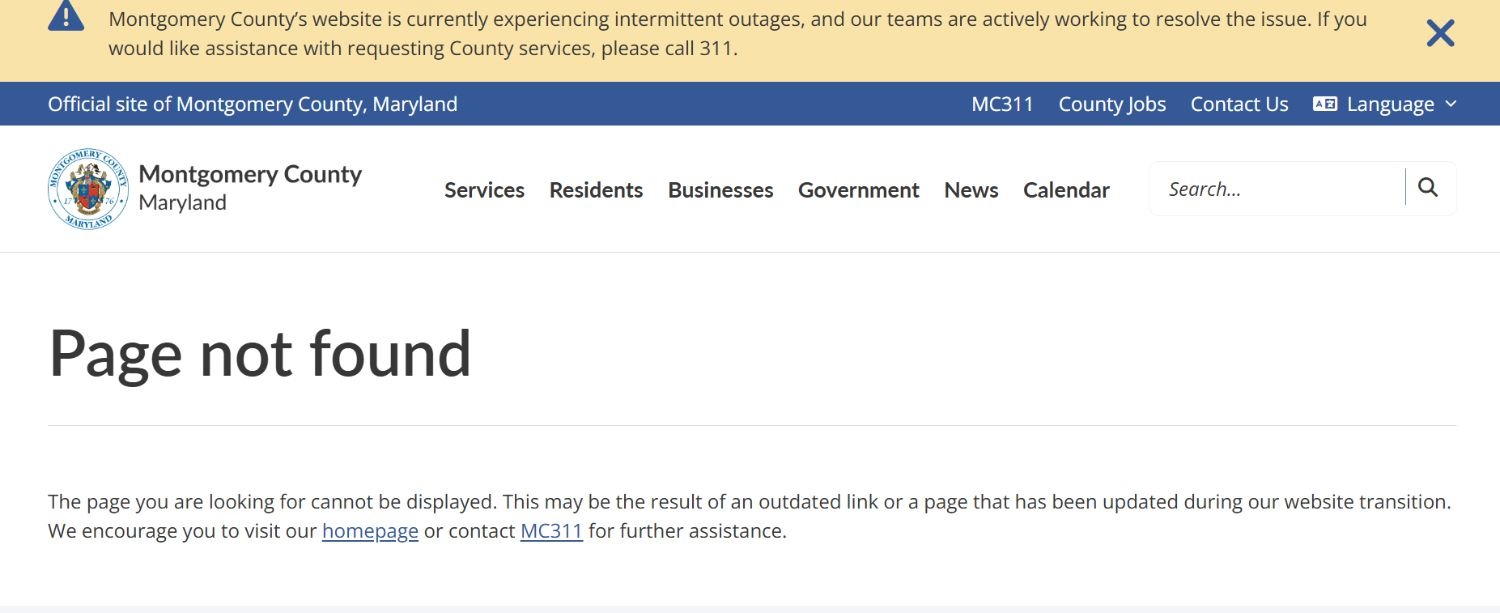
Montgomery County Website - www.montgomerycountymd.gov
has a new website. Unfortunately, like the County Council, it's not working!
________________________________________________________________________________________
