Friend The Disinformation Campaign Behind the University Boulevard Corridor Plan EPIC’s Bottom Line - for those short on time The County describes the University Boulevard Corridor Plan as “data-driven” and “minimal impact.” But during the public worksession, officials acknowledged facts—including NOAH loss, redevelopment pressure, and renter displacement—that are not being emphasized in public presentations or outreach materials. This summary highlights the critical differences. Click to view PHP Worksession: https://bit.ly/LastPHPWorksessiononUBCP --------------------------------------------------------------------------------------------------------------------------------------------------------------------- Although key issues remain unaddressed and several concerns were left for future discussion, the University Boulevard Corridor Plan (UBCP) was voted out of the PHP Committee and will now move to the full County Council.The University Boulevard Corridor Plan (UBCP) passed out of the County Council’s Planning, Housing & Parks (PHP) Committee with a 2–1 vote: - Councilmember Andrew Friedson – Yes
- Councilmember Natali Fani-González – Yes
- Councilmember Will Jawando – No
EPIC monitored this worksession closely, and I suggest you make the time to listen for yourself.
Part 1 of this series shines a bright light on how data, language, and assumptions were framed in ways that present an incomplete and often misleading picture of what this plan will actually do. This is not about personalities or elections. This is about what was said on the record, how that data is now being presented to residents, and the consequences for communities along the corridor. Housing “Need” vs. Housing “Capacity”: A Manufactured Sense of Urgency During the worksession, the public repeatedly heard: “We have a housing shortage, and we must take bold action.” But what was not highlighted: - Montgomery County already has 85,000+ units zoned today
- There are 30,000–35,000 units in the development pipeline
- Developers are not building them because of economics — not zoning
When the public is told only the “need,” and not the “existing supply,” they receive a distorted sense of urgency that makes drastic upzoning seem unavoidable. NOAH (Naturally Occurring Affordable Housing): Acknowledged Loss During the worksession, Planning staff member Pam Dunn stated: “If you require no net loss of affordable units, a project might need 50% or 75% MPDUs. Developers won’t build that. You would need FAR 6 or 8. That’s the trade-off.” This statement is critical for public understanding. It means: - Protecting current affordable homes (NOAH) requires affordability developers don't want to provide
- Therefore, redevelopment under this plan will likely eliminate those homes
- The County understands NOAH will be lost, but this reality is not highlighted in public messaging
This is not speculation. This is the County’s own Planning staff explaining the policy trade-off. Displacement: Defined So Narrowly It Hides Real Harm County presentations often state: “No residents will lose their homes.” This statement relies on a definition of displacement that includes only full building demolitions and excludes: - Parking elimination
- Driveway removal or relocation
- Yard, tree, and fence removal
- Loss of ADA access
- Noise and pollution during multi-year construction
- Redevelopment pressure on multifamily buildings
- Rent increases triggered by upzoning
Residents experiencing any of the above impacts would not be counted as “displaced.” This creates the impression of “minimal impact,” even when the real-world disruption is substantial. BRT Impacts: The “125 Parcels” on Veirs Mill Talking Point (Data is not available for UBCP) Residents are told: “Only 125 parcels will be affected by BRT.” However, the number alone hides the extent of the impacts, which include: - Private land acquisition
- Driveways being cut or moved
- Parking spaces lost
- Direct impacts on small businesses’ access
- Removal of trees and buffers
- Noise and stormwater impacts
- Increased redevelopment pressure on older buildings
The impact is not the number. The impact is the amount and type of what is taken from each parcel. Transit & Traffic Projections: Best-Case Scenarios Treated as Guarantees Staff emphasized: - “Improved transit reliability”
- “Minimal driver impact”
- “Mode shift”
But what was not emphasized: - Most BRT segments remain unfunded
- Colesville Road BRT has been planned for a decade but not built
- Traffic will increase before any improvements
- Emergency response times may be affected
- Corridor reliability depends on full system buildout, not isolated segments
Projections presented as “expected outcomes” were built on optimistic assumptions that were not clearly communicated. Fiscal Data: Upsides Highlighted, Costs Downplayed Public-facing messaging includes: - Economic development
- Future tax revenue
What was not highlighted: - Rising construction costs
- The County’s budget pressures
- Infrastructure shortfalls in schools, sewers, and public safety
- Risk of incomplete systems if funding falls short
Fiscal framing presented a one-sided view of long-term impacts. KEY MOMENTS THAT DEFINE THE DISINFORMATION PATTERN These direct, factual, on-the-record statements illustrate the gap between public messaging and internal acknowledgement. Councilmember Will Jawando: Displacement Is Real Unless Guaranteed Protections Exist Jawando stated: “If a low-income renter is displaced, they are not coming back unless we require it.” This acknowledges the clear reality of redevelopment: - Without firm protections, renters will not be able to return
- Market-rate redevelopment does not produce affordability for current residents
- “Right to return” does not exist in the plan
This contradicts the broader narrative that displacement risk is “minimal.” Pam Dunn: Preservation Conflicts with Developer Feasibility Her statement: “Preserving all affordable units would require levels of affordability that private developers will not pursue.” Meaning: - The County understands NOAH will be lost
- The plan is designed with those trade-offs accepted
- The public is not being told this directly
Councilmember Natali Fani-González: A Misleading Statement About Duplexes During the worksession, Fani-González stated: “A woman on the corridor will now be able to build a duplex because of this policy.” For public accuracy: - Duplexes and ADUs have already been permitted for years
- This plan does not create a new right to build them
- The statement gives the impression of a benefit that does not exist
This matters because misleading on-the-record statements can shape public perception and community expectations. Numbers don’t lie — but they can be framed in ways that don’t reflect community experience.
BRT is only one part of what’s underway, and every resident deserves clear, complete information. Plan to attend tomorrow’s EPIC meeting to stay informed and prepared. ----------------------------------------------------------------------------------------------------------------------------------------------------------------  ----------------------------------------------------------------------------------------------------------------------------------------------------------------------- 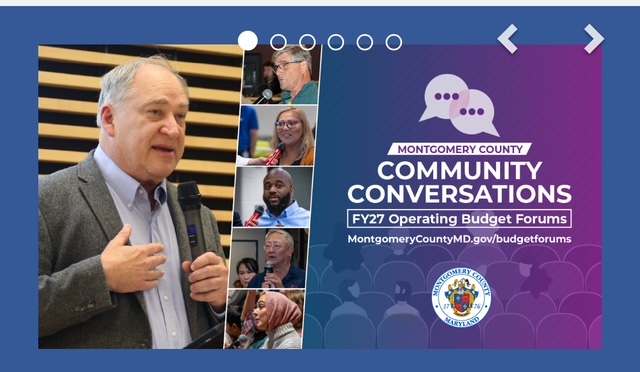 November 13, 12:30 – 2pm, come and tell us what your community needs and wants. Join us for our in-person forums across the County. - Leisure World, 3701 Rossmore Blvd., Clubhouse 1 Crystal Ballroom, Silver Spring (Only Leisure World residents may attend in-person at Leisure World)
- Satellite viewing location: Damascus Community Center, 25520 Oak Drive, Damascus
- Satellite viewing location: Wheaton Community Recreation Center/Senior Center, 11701 Georgia Ave., Social Hall, Wheaton.
- Riderwood Senior Living Community residents in Silver Spring can view the presentation in their homes on Riderwood TV.
The conversations will be televised live on the County cable station County Cable Montgomery, which can be seen on Comcast (Channel 6 and High-Definition Channel 996), RCN (Channel 6 and HD 1056) and Verizon (Channel 30). The forum also will be available on cable channels Takoma Park City TV (Channel 13), Montgomery Municipal (Channel 16, 997 Comcast), Corona Montgomery (Channel 10), and Montgomery Community Media (Channel 21), MCPS-TV 34/1071 HD Comcast, 36 Verizon, and 89/1058 HD RCN. If you can’t make it to one of the Community Conversations but would like to participate in the process, submit your question for County Executive Marc Elrich. | 